
Abstract A critical architectural decision in microfluidic diagnostics is the choice between linear cartridge-based routing and centrifugal disc-based routing. This technical note dissects the mechanical, fluidic, and workflow trade-offs of both paradigms.
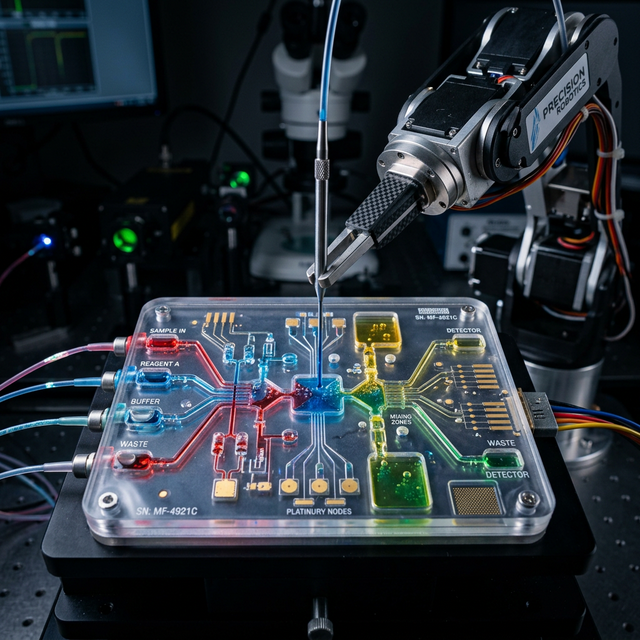
Linear Cartridges (Thermocycling & Complex Assays) Cartridge systems utilize active pumping (pneumatic or mechanical displacement) to move fluids through a linear sequence of chambers.
- •Highly precise control over fluid metering and pausing.
- •Ideal for complex, multi-step reactions like nucleic acid extraction and multiplex PCR.
- •Allows for discrete thermal zones critical for rapid thermal cycling.
Centrifugal Discs (High-Throughput Parallelization) Disc-based systems rely on centripetal force to drive fluids outward from a central reservoir into reaction wells.
- •Simultaneous processing of dozens of distinct assays from a single sample aliquot.
- •Simplifies hardware complexity by removing the need for positive displacement pumps.
- •Exceptionally fast routing times for simple chemical or immunological endpoints.
The BiQadx Hybrid Approach BiQadx systems deploy both architectures strategically. The EtherX-1 utilizes centrifugal routing for high-throughput biochemistry panels, while the Dr. POCT platform leverages precise linear cartridges for highly sensitive molecular and syndromic assays, ensuring the right physics are applied to the right clinical question.
Published: BiQadx Engineering Consortium